Saturday, March 17, 2012

Downloadable PC Full Version Freeware Turn-Based Strategy Game UFO: Alien Invasion Review

UFO: Alien Invasion is a freeware, turn-based strategy game for the PC that draws heavily from Microprose’s X-Com, a 1994 classic that has distinguished itself from other strategy PC games due to its unique gameplay design.

Before I launch into my review of this freeware turn-based freeware strategy game here’s a quick run-down of this game’s pros and cons:
Strong points:
  • Capable AI; enemies don’t have pathfinding issues
  • Awesome audio; background music is appropriately eerie while having a techno vibe
  • Developers have taken care to overhaul the id Tech 2 engine (which powers this game); implemented real-time lighting effects and bloom
  • The resource management-research part of the game is engaging and at times is even more engrossing than the game’s “battlescape” phase
  • Impressive content; team has an excellent writer (writers?)
  • Like most freeware open source PC games, this one is a work in progress. There are some features that are being overhauled. Things will get better with each released build.
Weak points:
  • The game’s graphics---given that it’s powered by an altered version of id Software's id Tech 2 game engine—is relatively abysmal. There’s just no way it can compete with games in the market today
  • AI is capable, but not awesome
  • Some sound effects and content are missing.
  • Like some strategy games, this freeware downloadable PC game is not for everyone. Casual gamers, for example, will have trouble digesting its deeper gameplay nuances
  • Like most open source games, this one is a work in progress. There are some features that are being overhauled. Some of the game’s weak points might prove to be deal breakers for some players.
I’ve been playing various builds of UFO: Alien Invasion over the years (early 2007 if memory serves; I’m not sure) and have watched the game grow as active members of the community patched and molded the game into the core developers’ vision of what the game should end up like. With version 2.3.1 featuring a working campaign finale and version 2.4’s launch just around the corner (not to mention Firaxis’ imminent release of their reimagining of the series), I deemed it the right time to give this budding project a full review.
The full review of this downloadable freeware turn-based strategy game after the jump.
Graphics

It may seem odd that I should discuss this aspect first, given that this freeware game is based on a PC classic that featured an unprecedented gameplay structure but I felt that I should discuss what I’ve listed as one of the weak points of the game. UFO: Alien Invasion may not have production values found in AAA games but its real strength is in its gameplay. It’s not for everyone, particularly those who nitpick about visuals. However, for those of you who have not pigeonholed yourself into the idea that all games should have AAA graphics to be worth playing, there’s still plenty to feast your eyes on; the developers of this freeware strategy game have made significant tweaks to UFO: AI’s engine.

For one, the real-time lighting in this PC game is superb; walls and other surfaces glow as coherent light from energy weapons knife through the battlescape. Ravenous fires of flamethrowers bathe aliens with high-contrast colors---shadows deepen while sides facing the flames light up. I also love the way how objects slowly get swallowed by darkness the farther they are from the camera. It’s chilling to behold a humongous alien Harvester from a distance in night battles; the effect is akin to an underwater behemoth resting just inside the periphery of your vision.

Burninate!

The developers also didn’t ignore minute details---even in aerial world map battles where the models are Lilliputian, aircraft with laser cannons will lance out shafts of coherent light while missile-equipped ones will unleash a swarm of projectiles at enemies. (Missiles are way too large though; I’m hoping this will be fixed in later builds.)

I’d be guilty of gushing (like the fan that I am) if I am to discuss just the positive side of this PC game’s graphics. This freeware strategy game’s graphics is far from perfect. Letting the game run at 1024x768 or 1152x864 resolution will only display incremental visual improvements relative to lower resolutions. Sure, graphics do appear crisper but the improvements are only obvious if you look for them. Compare this with other games wherein letting the software run at 1024x768 resolution would bring improvements that are immediately apparent.

For a military game wherein statistics play an important role, I’m surprised that the game developers haven’t introduced systems for players to immediately recognize who is who at a glance in large maps. I’ve taken it upon myself to use the game’s (non-functional) camouflage scheme to clothe soldiers in different uniforms to spot who is who; hence in my games, elites go out in arctic garb, rookies in urban, and competent and proficient troopers in jungle and desert camo respectively.

If the developers had implemented a system wherein players could apply color schemes or rank stripes to the soldiers’ armor it would have been so much better. I suppose this is asking too much as this game is freeware but think about what THQ is doing with its Warhammer 40,000: Space Marine video game---the skin DLCs aren’t selling like pancakes but they are selling! Customization appeals strongly to a wide player base, not just strategy gamers. I’m very confident that capitalizing on customization would give this game a solid boost in terms of gameplay and user-friendliness.

Messy.

The game also treats fallen enemies alike: stunned aliens (from stun prods or electro lasers), disemboweled aliens (from blades), burnt aliens (flamethrowers, laser weapons), blasted aliens (grenades, plasma blasters) ---all these fall, crumple, or cartwheel into prone bodies covered with spattered ichor. For what it’s worth, the aliens do assume multiple death poses but it would have been a huge plus for aliens hit with plasma blaster fire to leave cauterized chunks or for flamethrowered ones to leave blackened bodies. I’m sure these effects be implemented in future builds though, seeing that these can be implemented with (relatively) minimum fuss.

X-Com fans should be warned that this downloadable freeware strategy game’s environment is static. Here, no walls can be brought down by explosives and even cardboard crates hit with a rocket launcher display a resiliency that would make scientists specializing in armor R&D turn a vicious shade of green. (Hmm, there’s an idea there…)

Finally, permit me to insert a strong personal opinion that most guys in the UFO: AI forums disagreed with: the plasma pistol found in this freeware turn-based strategy game looks as if it has been ripped from the Halo universe. The curves, even the color---which is blue---look disturbingly close to the violet Covenant plasma rifle found in the Halo games. I don’t know; what with the multitude of games nowadays, certain amounts of parallelism are inevitable but in this case, the similarities are just too close. I’m hoping that the design will change in future versions of the game.

My friends commented "Halo?" when they saw this screenshot.

Gameplay – Resource Management and Research

First off: UFO: Alien invasion is NOT X-Com. And while I haven’t played any of the Microprose games, I’ve interviewed friends who I’ve given a copy of this freeware strategy game to and all of them opined that the experiences they had with both games were vastly different.

This freeware turn-based strategy game however, uses X-Com’s dual aspect gameplay structure. There is the resource management-research aspect where you juggle funds, buildings, and manpower. Initially, you are given a base with enough facilities and funds to assemble an 8-man squad.

Wait. What’s the squad for?

UFO: AI puts you in the shoes of a commander tasked with constructing bases, commanding squads, and reverse-engineering alien technology to combat an increasing number of alien incursions into the planet. Every time a UFO lands, you should ideally have a base nearby to scramble and launch a squad that would neutralize the hostiles’ mission. Your force is funded by various nations so it is imperative that you respond rapidly to each alien threat. Failure to do so results in a country changing its opinions of your forces’ importance (represented in “mood” levels; “Exuberant” countries will continually supply you with funds). Fail to deliver continually and the world’s governments will withdraw their support, ending the game.
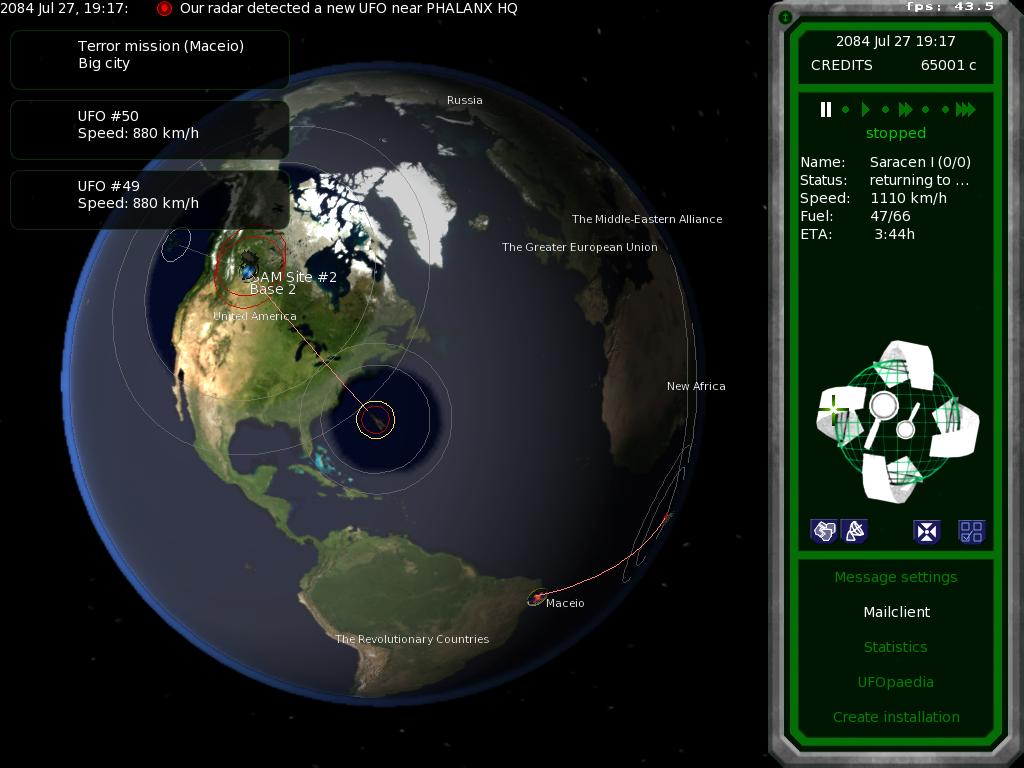
A long-range interceptor heads for home while a UFO snoops around. Meanwhile a dropship full of soldiers scrambles in response to a terror mission.

With increasing funds, you should be able to erect bases in various parts of the world, the user interface of which is a beauty to behold; there is even a day-night cycle as the Earth spins on its axis. On the world map interface (henceforth known as the “Geoscape”), you can erect bases, surface-to-air missile (SAM) and radar sites, and UFO yards, structure that act as humongous storage houses for UFOs salvaged from battlefields. You just can’t place structures willy-nilly. Smart placement is critical here as there is a structure cap in place. You can’t, for example, cram the entire planet with SAM installations as the implication of this scenario is game-breaking---UFOs would be continually shot down wherever they appear near land masses. Also, bases are expensive and constructing one entails that you have to have enough spare cash to construct internal SAM sites (in addition to the installations) and a well-armed squad to defend it if a UFO manages to puncture through your point-defense array and land on your base.

The user interfaces for bases are 5-slot x 5-slot plots. You construct buildings within these. Take note however that some buildings are 2-slot affairs so plan carefully. Is the base you’re erecting going to be a production facility? You should erect more workshops and living quarters for your workers. Is it going to be a research facility? You should make more laboratories and quarters for your scientists and maybe plop in an alien containment facility for your braniacs to experiment with living aliens. Aircraft production bases should have spare hangars in them. (Classic gamers should be pleased to know that this free X-Com clone also has large and small hangars for dropships and interceptors.)


What strikes me as odd in the base building aspect is that you need to have a dropship to recruit and equip soldiers in; there’s no way for you to assemble a base defense force if you don’t construct a large hangar and acquire a Firebird Dropship. The whole thing is a 120,000-credit investment so it’s an awful waste of resources if you just want to build a production facility. Granted, the dropship could come in handy if a UFO lands nearby and all your other bases are too far away. Still, in this freeware strategy game, there are times where you have to penny pinch just to coast through, making the whole dropship pre-requisite a pain. (Maybe in future builds they should relabel the large hangar as “Large Hangar/Barracks.” This way, without dropships, players can still assemble a squad. Later, if funds allow---or base design direction alteration dictates---players can plop in a dropship without needing to replace the structure.)

When you have multiple bases already, you can also transfer assets (aircraft, ammo, alien artifacts, etc) and personnel to and fro among the bases. (The “Transfer” menu can be accessed via the base UI, making the whole process a breeze.) You can also scroll through various bases by clicking the left and right arrows in a base UI, negating the need to exit to the Geoscape and clicking bases.

Gamers who aren’t into economic management might find the above as an unexciting gameplay design but this freeware strategy game’s main appeal is in the way you direct and witness your armed forces’ steady progression in terms of technology and proficiency. Almost after every engagement, your Research & Development wing sends you project proposal letters to reverse engineer captured alien technology. You can then choose among the numerous choices on what technology branch to tackle first. Should you prioritize improving the defenses of your troops or should you allocate all your scientists into researching better weapons first? Is your base defense your weak spot? Should you prioritize outfitting your interceptors with energy-based armaments?

Questions like these bring a different dimension to this free turn-based strategy game. When you see reports that your scientists are nearing research completion on new technologies while your workshops are churning out your first batch of plasma rifles, you can’t help but stay glued to your chair and see how your squads perform with the new equipment.

You also have to choose wisely while equipping troops. Every month, your soldier, pilot, scientist, and worker candidate pools grow. While you can just take in employees from the other pools, picking new soldiers isn’t just a matter of checking boxes from the list. Do you need a heavy weapons expert? Choose one that has a high “Heavy Weapons” rating. Need a medic? Choose a candidate who has a huge “Mind,” “Speed,” and “Close Combat” stats. This way, you can outfit him with a medikit in one hand and a one-handed ranged/melee weapon in the other. A high speed rating will ensure he has a prodigious amount of time units with which to spend walking to an injured squadmate.

Your soldiers’ statistics grow over time according to what weapons you’ve given them. Thus, grenade launcher users will become more accurate on where their ordnance bounce and explode and medics will recover greater amounts of hit points. Contrast this with X-Com where stats are limited to strength and throwing and firing accuracies and you can readily see the gameplay deviations. In this free X-Com clone, your elites would be specialists, not jacks-of-all-trades. This design scheme makes you more protective of your squad. Lose an elite in a skirmish and chances are you’ll be hard-up to replace him; candidates with “Competent” stats are few and far between. Ones with “Proficient” stats are rarer still.


Music and Gameplay – Combat

Combat in UFO: Alien Invasion takes place in maps called “Battlescapes.” Unlike in the Microprose games, battlescapes in this freeware strategy game are rendered fully in 3D. Thus, you can zoom in and out, rotate the levels around, and even swoop in behind your soldiers’ backs to better gauge what they’re seeing. You can also inspect each floor of each structure by using level up and down keys. Unlike in X-Com, going up one level doesn’t render what’s below invisible; you can still see soldiers you’ve positioned in the sidewalk while you inspect the layout of the second floor of a building.

While at any time you can see what every structure has right down to tables and telephones and even wall hangings, aliens not in your soldiers’ lines of sight are rendered invisible. This makes for a tense gameplay experience. Nothing is more frightening than an alien equipped with heavy weapons round a corner near your precious elites. In cases like the one mentioned, you better hope that the extraterrestrial is as surprised as your troops are.


Turn-based strategy gaming suits the horror-tinged UFO: Alien Invasion; in the AI’s turn all your troops remain immobile while you hear footfalls within buildings and the death cries of civilians as unknown hostiles open fire within the edifices. The game’s music is also well done; in fact it can go toe-to-toe with some of the best AAA tracks out there. Except for two tracks that I strongly dislike, the game’s background OSTs are bass-heavy techno affairs that sound eerie while at the same time upbeat enough that at times make me forget that I’m playing a turn-based game. Think about Martin O’Donnell’s Halo tracks and you get the idea. (In fact this freeware strategy game’s impressive intro music reminds me a bit of O’Donnell’s “Under Cover of Night.”)


As you probably surmised by now, this freeware PC game uses a time unit system. Units with more TUs can do more in a given turn. Each action in the game---crouching, looking around, walking, firing---has a corresponding TU “price” and troops have their own individual TU amounts with which to spend. I’m pretty sure TU amounts are directly affected by the Speed and Strength attributes but I’m not too sure if the latter has been implemented seeing that units with stuffed inventories don’t lag behind those with lighter loads (ie, Item in holsters and backpacks don’t affect TU amounts). I could be wrong but I’ve several rookies hefting Plasma Blasters with their packs and belts filled to the brim with grenades and medikits and I’ve never felt that their TUs have dipped to inconvenient levels.

Each weapon has alternate fire modes. Plasma Rifles for example have a handful of firing options. These are “Full Auto,” “Aimed Shot,” “Snap Shot,” and “Burst” modes. Even fragmentation grenades have two modes to choose from (“Lob” and “Roll”). Almost all firing modes have wildly deviating TU and accuracy ratings. Full Auto modes for example, gobble a huge chunk of TUs, entailing that you have to get into position to use them (and have enough TU afterwards to duck back to cover). It’s also wise not to employ that firing mode if you’re firing at targets than a city block away---doing so would ensure that most---if not all!---your shots will miss. Aimed Shots are, needless to say, better at sniping targets. (You could also increase your accuracy by crouching though the act does consume 3 TUs. Considering that, on average, your troops have 30 or so TUs, this is a significant percentage. Moving while crouching also eats up greater amounts of TUs than just walking.) It’s variables like these that demand you optimize firing arcs, cover, and squad proximity when moving your troops around in this freeware PC game. If you’ve enjoyed games like Final Fantasy Tactics, Tactics Ogre, or even any of the GDW tabletop games, you’re sure to have a good time with this one.


One of the complaints I have about this game is that while it has a robust collection of levels, they’re not as numerous as I would have liked them to be. In the course of the game---wherein you have to speed up the passage of time so your production and research rates can go at a brisk pace---numerous UFO landings (and crashes!) will occur. These recurring events demand that you send in troops and enter the battlescape phase of the game multiple times. Thus, there will come a time that you will have seen all the levels this game has and replaying them again and again might take a toll on you. (There is a cool randomization system that randomly repositions the game’s assets---houses, rock formations, buildings, aircraft, etc---but it can only do so much. Still it’s a nifty feature.)

Also, there are two maps where the first turns almost always play out the same way. There’s this multi-level parking lot where aliens invariably spawn at the topmost floor. The best way to the top is through a huge stairwell located at the front and it’s here that most of the action transpires each and every time. (There are two more stairwells at the rear of the structure but these are veritable Indian passes, letting only one soldier negotiate through their narrow confines.) The second are maps wherein you’ve downed small fighter craft. Here, two aliens always---always!---spawn near my grenadiers, guaranteeing first-turn, 2-alien kills.


These are, however, minor complaints and do not hamper the experience in a significant way.

If at times you just wish to play the economy-research-production facet of the game and don’t want to be bothered by battlescape sequences, the game does provide you with the option to resolve battlescape action with the “Auto-Mission” option. One click is all it takes to resolve a certain mission. Be forewarned though that:

1. There’s a greater probability that you will lose; quick save first before committing.
2. The feature is largely a work in progress; currently results seem to be random as I’ve seen a veteran squad lose multiple times.
3. There are certain missions that can’t be resolved using this option.
4. Loot acquired will be significantly less than what you will get with regular missions. A developer has also stated that experience gained in Auto-Missions is substantially less.

The feature is, needless to say, handy if you’re short on time and just wish to complete research on a certain technology before ending your gaming session.

A caveat to veteran X-Com players: this game won’t allow you to save in the battlescape, ensuring that players won’t be able to “cheat” by reloading saves mid-skirmish. This is a pretty subjective topic but I agree with the developers on this one. I don’t want my gameplay to devolve into strings of reloads after missed shots and savefests after killing multiple aliens.


Finally, players should be aware that flashbangs and smoke grenades have been taken out of version 2.3.1. Developers have stated that they will bring them back at a later date. Also, faithful to the source material, this turn-based freeware game isn’t story-driven. You won’t see cinematics and any pivotal points mid-game wherein paragraphs of text scroll by (ala Transformers: War for Cybertron). This is just a minor complaint (after all the first two X-Com games did succeed without these) but implementing cutscenes would greatly diminish the feel that the game is just a string of random, turn-based battles and more of a cohesive, singleplayer campaign that’s fueled by a compelling storyline. (Limited funding wouldn’t pose as a major problem as the developers could implement simple but effective narrative pieces like that found in the Neverwinter Nights or Homeworld 2.)

As it is, UFO: Alien Invasion is fun and addictive but sometimes I just can’t shake off the feeling that I’m coasting through a series of random battles. There’s a story and it’s well-written (and the R&D’s project proposals are certainly impressive pieces) but it just comes off as a vehicle to string together the different elements of the game. As a result, I don’t feel that the world is on the brink of losing to an invading force and that the entire world is working together to fund my defensive campaigns. Every time I play, it’s just me and the AI moving pieces across the board in a bid to outsmart each other. Don’t get me wrong, this game IS more than good but when the wheels start turning, the background story remains just that.


Geoscape (Aerial) Combat

While aircraft combat in UFO: Alien Invasion is just a footnote in the game, it is by no means a poor aspect. When responding to alien terror missions, you get to see your dropships fly from your bases to the beleaguered areas. While these really have no business engaging UFOs, sometimes you will have no choice but to fly them to places beyond the reach of your interceptors and anti-aircraft emplacements. Here in these remote places, things can get hairy as marauding UFOs can appear out of nowhere. You can scramble your long-range interceptors though and hope that they’ll catch up and defend a fleeing transport. While not a major component, Geoscape combat still presents itself as an entertaining mini-game that’s still firmly integral to the UFO: AI experience.

Geoscape combat at this point is not fully fleshed out: it lacks sound effects; you won’t hear laser fire or even radio communications among aircraft.


“AI” is for “Alien Invasion”

One thing I have to grind about this freeware game is its AI. It’s competent; it does all that it is expected to do: it doesn’t have a problem with pathfinding, it fires when it sees a soldier, and it can use multiple types of weaponry. However, it still has a lot to go. I don’t know what the current standard is in turn-based strategy but I am dead sure the AI here isn’t as smart as say, Galactic Civilizations 2’s. I haven’t seen it coordinate squad efforts. Aliens do not: 1.) Heal squadmates 2.) Rely on each other (instead they operate individually) 3.) Use cover 4.) Crouch to improve their accuracy 5.) Use grenades (in v2.3.1; I’ve seen them use grenades in earlier builds though.)

There’s also a game feature that only affects aliens—outgunned ones sometimes drop their guns and cower, crouching while holding their heads. It’s a nice feature but I hope to see this applied across the board in future builds; soldiers have a “mood meter” (judging from the sine wave thingamajig with the smiley emoticon in the inventory window) but I don’t think this has been implemented yet as I’ve yet to see one of my troopers lose it.


Aliens also don’t prioritize your forces; they invariably make beelines for civilians if any are nearby. Luckily, though, civvies can be trusted in fleeing from hostiles. My only complaint is the latter’s animation: they may run from the aliens but when at rest, some put a hand on their hip, making them appear nonchalant about a UFO parked in the neighborhood while a swarm of homicidal extraterrestrials are making shish kebabs out of their families and friends.

Nothing bothers me more though than the wallhacking aliens found in this game. Some species have infrared vision, making them see troops even behind a wall. While this is cool, the AI can’t seem to realize that walls stop shots; thus you’ll see aliens wasting precious time units as they use the Full-Auto mode of their weapons behind a wall, trying to shoot through it. You will even see some of them trying to fire through floors in a vain attempt to shoot soldiers that are below them. It’s this bug that seriously handicaps the AI.

Surprisingly, though, even with all these complaints, the combat in this freeware game remains an engaging affair as the AI can be counted on to rack up horrifying kill counts if you move your troops around carelessly. While it’s not Deep Blue, the AI is competent enough to give you an entertaining time planning tactics in a detailed 3D environment.


Bugs – The Other Alien Threat

While the game has bugs they occur rarely enough that I don’t find them to be major issues. To date, I only had five crashes (game freezing after successfully loading up). There’s also an issue with slopes—sometimes if the inclines are gradual enough, aliens and troops alike inexplicably vanish as they pass through the terrain. I’ve only seen this happen thrice though. However, in the “Convoy” map, parts of the grassy slopes can’t be traversed through. The most annoying bug I had involved the game exiting back to the world map UI after I tried to make a soldier pick up an item from the ground—this after I had invested several minutes in an anti-terror mission.


Summary:

UFO: Alien Invasion may not be a next-gen game but if you don’t mind its archaic engine and the fact that is being developed by people who aren’t financed by a major game publisher, you’re sure to find an almost unparalleled experience here. The game’s two-fold structure means that people who are macromanagement-oriented will have an engrossing time allocating meager funds and manpower to base defense and R&D while turn-based strategy enthusiasts won’t be disappointed with the battlescape aspect of the game. If you are both, be warned: UFO: Alien Invasion is one of those games that are so addictive, you can’t help but invest several weeks of your life into them. Be prepared to stave off alien terror campaigns way into the wee hours of the morning.

Tilt: 7.5 – This game could have scored an 8.0 or even an 8.5 but some missing content (aerial combat sound effects, several project proposals having blank pages, etc) clearly mark version 2.3.1 as a work in progress. There are also bugs that rear their ugly heads from time to time. Also there are still some tech tree paths that aren’t complete; case in point: the Medium Alien Armor technology branch.

Graphics: 6.5 – id Tech 2 graphics bring down this game in the graphics department. While the team has made huge (nay, gargantuan!) leaps in visuals in 2.3.1, I can’t give this game a 7.0 if I am to maintain consistency in my ratings (I gave FEAR 3 a 7.9). Once the new models and UI get implemented though, this can easily score a 7.0 or even a 7.5.


Gameplay: 9.5 – This is UFO: AI’s forte. Maintaining the X-Com formula ensures that purists who are looking for an X-Com experience will have a blast playing this one. Positioning troopers across detailed 3-dimensional, multi-level landscapes while seeing alien craft vomit a whole platoon of hostile ETs who then either melt into the shadows or charge towards your troops is an experience few games today offer.

Sound: 7.5 – The original tracks found in this game is nothing short of amazing. They’ve really poured creative talents into the background music. By themselves, the tracks can collectively score an 8.0. I’ve scaled down the rating though as there are sound effects that do not quite sound right; the shotgun and assault rifles for example, sound too sibilant and weak. Also, Geoscape combat could use some sound effects.

Replayability: 9.0 – No two skirmishes play out the same way. The initial excitement might wear off once you finish the campaign but the battlescape combat never gets old. The challenge the AI presents isn’t overwhelming but it isn’t mind-numbingly easy either. Also the research-management phase and the Geoscape UI tie in well with UFO: AI’s core gameplay aspect, adding different avenues of goal achievement other than eliminating alien threats.

Final Score: 8.0

>>> Download the freeware PC turn-based strategy game here

>>> See more reviews of freeware PC strategy games HERE


>>>Click here to read more...

Wednesday, February 29, 2012

Freeware Turn-Based Strategy Game Wesnoth – Version 1.10 Released

Fans of PC turn-based strategy games rejoice! After two years ever since they released version 1.8 of their freeware PC game, the developers of Battle for Wesnoth have released version 1.10. This stable downloadable version is compatible with past builds (version 1.9.x) so gamers who are in the middle of a campaign shouldn’t fret.

Battle for Wesnoth is one of the many PC freeware games that are actively developed. Backed by a strong community who have contributed heavily into the game’s art, audio, and gameplay changes, this freeware strategy PC game touts impressive aesthetics and game content. The 5 million downloads the PC game has garnered is a testament to the impressive standards the game has kept.

Taken from the official Battle for Wesnoth site

Minus the multi-level terrain, Battle for Wesnoth resembles games like Tactics Ogre and Final Fantasy Tactics. Like the aforementioned games, Battle for Wesnoth features chibi-like characters and medieval settings.

The developers have also released a bugfix immediately after version 1.10’s release. The changelogs of both versions are found after the jump.

Version 1.10.1:
* Campaigns:
* Son of the Black Eye:
* Removed Al'Brock and Flar'Tar death as defeat condition in objectives in
Civil War.
* Tutorial:
* Fixed bug #19316: Narrator messages are now translated.
* Replacd $unit.type by $unit.language_name to make a string completely
translateable.
* Under the Burning Suns:
* Made it so that Kaleh gets the default AMLA after he's been fully
upgraded.

* Language and i18n:
* New translation: Ukrainian.
* Updated translations: British English, Chinese (Simplified), Dutch,
Finnish, French, Galician, German, Hungarian, Indonesian, Irish, Italian,
Latin, Norwegian, Old English, Polish, Portuguese (Brazil), Serbian,
Spanish.

Taken from the official Battle for Wesnoth site


* Multiplayer:
* Fix an accidental terrain type change in Isar's Cross.
* Fix attacker side being human in 6p_Team_Survival.

* Whiteboard
* Fixed bug #19369 : Using planning mode can cause losing ability to move my
units
* Fixed bug #19408 : Crash shortly after executing invalid multi-turn move

* Miscellaneous and bug fixes:
* Fix wrong preferences path suffix (1.1 instead of 1.10) on Linux and other
platforms using XDG layout (no compiled-in preferences path override).
* Fix bridge/rail transitions to each other.


Version 1.10.0:
* Campaigns:
* Legend of Wesmere:
* Scenario 3: Fixed bug #19067: Control over Galtrid's side stays with the
player after the arrival of Kalenz.
* Scenario 22: Fixed bug #19236: Cleodil was missing and no recall list.

* Language and i18n:
* Updated translations: Chinese (Simplified), Chinese (Traditional), Czech,
Finnish, French, Galician, German, Hungarian, Italian, Latin, Lithuanian,
Old English, Polish, Serbian, Slovak, Spanish.

Taken from the official Battle for Wesnoth site


* Multiplayer:
* Allow tab completion of player names in commands (bug #19284).
* Fixed eras other than the default breaking 2p_Hornshark_Island. If a player
has a faction not in the default era, a standard set of units (aimed at
Khalifate) is used now.
* Fixed bug #19083: allow attack to happen normally without causing OOS if
turn time runs out in attack selection dialog.

* Whiteboard:
* Fixed bug #18635: Percentage not displayed for units selected at their
future position.
* Fixed bug #19142: attacks can be simulated between units (for which this
shouldn't be possible).
* Fixed bug #19221: Assert when a whiteboard move-attack wins a scenario.
* Fixed bug #19222: After 'delete planned action', the unit is almost
invisible.
* Fixed turn not finishing when moves were planned for future turns.


>>>Click here to read more...

Thursday, February 9, 2012

Wizards' New Direction with Magic: The Gathering - Duels of the Planeswalkers 2012

[All screenshots here are from the 2011 version of the PC game.]

So Stainless Games and Wizards of the Coast have just released new decks for Magic: The Gathering – Duels of the Planeswalkers 2012. I'm very happy with "Forest's Fury," a green deck focused on quickly fielding huge treefolk that buff each other and/or spawn more creatures. While this concept is nothing new--certainly sliver and goblin decks have introduced this to players in the late 90s--it's definitely something that the aforementioned developers are continuing to bring to the table (pardon the TCG pun) decks that are more geared towards establishing victory-assuring combos. They're not by any means decks that have the same complexity as Kai Budde's red-artifact deck that he used in the 1999 MTG World Championships, much less Jakub Slemr's black control deck, but this speedy turnout of new decks is starting to revive my interest for the TCG.


Read more after the jump.

I started to slow down on purchasing Magic cards in mid-2000, when it became clear that the rich kids had a greater probability in winning matches. I mean some of those guys were crazy; some spent nearly $75 every week on booster packs. While the diversity of decks that came out during those times have been unmatched so far, the competition was stiff to the point that trying to win was nearly an exercise of futility. There I was spending about $5 a week on packs and some of my friends were spending more than ten times that amount. I was packing an Armageddon-less en-Kor deck and they were unleashing decks that had Living Deaths, Wraths, and decks that had that infamous Tradewind Rider combo.

The last straw was when I noticed most of the players were copying decks made by pro players. That did it for me; not only did that raise the bar for deck building, it also stomped dead creativity.

Fast forward to the future and a friend gifted me Magic: The Gathering – Duels of the Planeswalkers 2011. I played it for a while (barely reaching four hours) and then stopped. I was expecting full deck editor but the game didn't provide that. Sure it had unlocks, but it didn't allow you to swap out inferior cards; only add the unlocked cards in. It was a strange design that broke the deal for me.

This one surprised me. The Kor are back? Nice.

Barely a year has passed since that gift when this new incarnation arrived. Magic: The Gathering – Duels of the Planeswalkers 2012 still doesn't provide players to build decks from scratch but at least now it allows you to swap out old cards for unlocked ones. While this initially put me off, what Stainless Steel and Wizards of the Coast are trying to do gradually dawned on me: here at last is a version of the game where the playing field has been leveled. No longer do you have to be at the mercy of rich kids who can shell out an insane amount of moolah buying booster packs. The decks might sometimes be frustrating in their simplicity sure, but at least you won't get burned to cinders by someone who has got a trust fund backing up his collection of cards.

I'm hoping that Stainless Steel Games and Wizards would release more combo-intensive decks that are in the same mold as those of Kai Budde's and Slemr's but I also recognize the need for a more developed AI if we are to see decks like that in the future. Also, releasing decks that rely on combos might be too weak if they are to be tailored to be on the same level as the existing ones in terms of win probabilities.

Still this direction that Wizards is taking might just be the very thing that will bolster the TCG community.


This was one of the best turnarounds that almost happened. At 3 life, I casted the sorcery Overrun, winning me the game--or so I hoped. The next thing I new, the AI casted Unsummon on my 10/10 wurm. You got to hand it to Garfield for creating one awesome game.


>>>Click here to read more...

Thursday, February 2, 2012

RAGE PC Review

RAGE’s developer, id Software, has ever been on the forefront of technological innovation. They—along with John Romero—have developed and launched the first games to define the first-person shooter genre, coined the term “Deathmatch” (Romero), and with the release of Doom 3, launched the very first game engine that introduced specular highlighting and bump mapping, two features that catapulted video game graphics to new heights. They even trumped Romero a year after he left id Software with the Quake 2 engine (which featured advanced lighting and 3D acceleration, forcing Romero to further delay the launch of the ill-fated Daikatana).

While I never got to play Quake 2 and three when they launched, I did spend a substantial amount of my life playing Doom 2 and 3, two games that really impressed me. id Software’s dogged persistence to bring to the table avant-garde technology and/or innovative gameplay concepts with each release firmly made me a follower of the company’s brainchildren.

Fast forward several years later and RAGE got released. Read this RAGE PC review to find out the answers to the following: Did Carmack and company manage to impress the industry once again? Has the game’s gameplay concepts manage to shape another niche in the PC first-person industry? This RAGE PC review discusses the aspects that make RAGE an above average game and the flaws that pull it down from joining the elite ranks of its id Software forebears.


Several of the flaws are the bugs; game-breaking ones at that. Let’s delve into these first before the good parts.

The RAGE PC user review after the jump.

The Horrors of the Future

[Note: This review was made before the 1.2 patch came out.]

When I first started the game, a powerful and haunting intro provided me a glimpse of mankind’s valiant efforts to protect its intellectual elites from an asteroid impact. The cinematic’s series of scenes that alternate between asteroid Apophis’ inexorable progress towards our planet and the pre-cryostasis sequence that Earth’s inhabitants subjected themselves to effectively sets the player’s mindset that the survival of Earth’s civilization as we know it will still rise from the ruins of the impact.

After this impressive start though, things take an apocalyptic turn—both in the story and the technical aspect of RAGE. The game proper launched—and greeted me with psychedelic bands of white, green, and black. I got it to work by exiting Steam and restarting the game. To my consternation, I found that the game didn’t autosave after the introduction, forcing me to watch the whole sequence again. Up to this day, I still get this bug occasionally when I start a new campaign. RAGE seems to loathe PC applications running in the background. Letting other programs run while launching RAGE oftentimes causes this glitch to rear its ugly head. To say that the bug is annoying is an understatement; if there’s ever a thing that totally breaks the immersion, it’s a glitch that forces players to watch a game’s introduction 1-3 times before letting the thing run.

AAAAAAAAAAAH!!

The game also intermittently suffers from this bug when loading new areas. However, this is easily solved by reloading the autosave that kicks in at the start of each level so it’s more of an annoyance than a major issue.

What will really vex you is the infamous RAGE texture streaming pop-in bug: every time you abruptly turn around, you will notice the game trying to catch up with you; textures will pop-in belatedly—think 640X480 textures being rapidly “clothed” with higher resolution ones. While I have solved this (see my “How to Solve the RAGE Texture Streaming Pop-in Bug” guide), this does present problems to those who aren’t into tweaking PC games.

There are also mini-freeze bugs that last for 2-3 seconds though these happen only rarely on my system.

The above aside, RAGE is a great PC first-person shooter. True, it does have some glaring flaws but this FPS still provides powerful peregrinations across a dystopian landscape.

>>>See my other PC retail games reviews HERE

>>>See my other FREEware PC full version games HERE

Which is more sickening? The mutant growth or the blurred textures? You be the judge.

Gameplay
Before the RAGE PC review proper, I would like to stress this out: RAGE is NOT an RPG-Shooter hybrid. Many people discovered to their chagrin that it’s not a Fallout-like game and have expressed their ire in video game forums. I find this strange as id Software never actively advertised it as such. Granted (and as I’ll discuss later), there are several aspects that might
initially mislead the player into thinking this PC FPS is an RPG-shooter hybrid, but RAGE is more of a full-on shooter with several minute RPG aspects thrown in. I’d like to think the these aspects as things that break the monotony of a pure shooter and not as failed efforts on id Software’s part to make an RPG-shooter game as others purport.

There; you have been warned.

RAGE tells the story of an Earth ravaged by an asteroid impact. At the game’s onset, you emerge from an “ark,” a massive underground metal sphere that was designed to protect mankind’s elite. The plan was to preserve scientists, leaders, and military personnel in numerous arks and then rebuild civilization several years after Apophis hits the planet. Unfortunately, something goes wrong and the timing of your ark goes haywire; you emerge several years late than the rest of humanity’s remnants. Upon stumbling out, you immediately get ambushed by bandits but get rescued by the head of a nearby settlement. From there you embark on a series of quests that pit you against bandits, mutants, bands of hostile settlers, and the Authority, a faction that reminds me strongly of Fallout’s Brotherhood of Steel.

No, he's not one of them but see the finger? He's trying hard to be one.

What bothered me was how the game is structured; RAGE sets you off on a string of missions that never fully captivates the player. Why should I help these people? If the missions are so important why do they set me off alone against swarms of mutants? What motivates these other factions? Why should I exterminate the whole lot of them? While the characters in the game are certainly interesting enough—the crazed, rambling hermit and the silver-tongued TV show host come to mind—the PC game just doesn’t draw the player in to really care about the world RAGE is set in. Several scripted events or cutscenes would have helped. As it is, this dearth of compelling reasons why you should throw your lot in with the quest-giving NPCs leaves the game’s plot uninteresting.

And then there are choices: when NPCs give you a quest, you are given the choice to accept or decline. This is just an illusion of freedom. In reality, choosing “Decline” doesn’t divert the plot into another story arc; you’re just effectively putting that quest on hold. Some of them you can take later but some need to be accepted and completed before the game can progress. As has been mentioned, RAGE is NOT an RPG PC game.

This isn’t saying that RAGE is a bad game, far from it—every time I start the game hours fly past without me noticing. It has flaws but it is as (bugs aside) immersive as the best ones out there.

RAGE’s gameplay is a breath of fresh air from all the games that have copied Halo’s two-weapon inventory system. While I still prefer the latter (being more realistic and tactical in the sense that it forces you to think about which weapons to carry in what situation), I was pleasantly surprised that id Software has stuck with the old school tradition of letting you carry a whole arsenal with you.

Killburst pistol ammo is good for mutants who have a penchant of going up close to eat fistfuls of lead.

And what an arsenal it is. In the course of the game, you’ll acquire a pistol, a shotgun, an assault rifle that looks every bit a Kalashnikov, a crossbow, a sniper rifle, an Authority assault rifle, and a rocket launcher. There’s a weapon you get to use in the finale but I’ll leave that for you to discover. It’s gratifying to fire these; unlike in Doom 3 where most of the conventional weapon sound effects lean towards the higher frequencies (the assault rifle for example, sounded too tinny), the weapons in RAGE sound just right: massive and powerful without going overboard. Sure, there are other games whose weapons sound better (Killing Floor comes to mind) but RAGE is up there with the better ones.

What ups the ante in the weapons department is the ammunition system of the game, which makes the firearms veritable Swiss Knives. Running low on rockets? Craft Pop Rocket ammunition for your shotgun. Getting peppered by long-range fire from hostiles who are in close proximity to each other? Load your crossbow with mind control bolts and inoculate one of them with nanites, making the hapless individual a ticking time bomb that you can control and detonate at will. Ran out of sniper rounds? Whip out your pistol, load it up with armor-piercing Fat Mamma rounds and use a makeshift scope to take out targets from afar. It’s this system that makes RAGE fun to play. Even your other items can be upgraded or converted with the recipes that you can buy from merchants. Grenades for example, can be converted to EMP ones, which are very useful for shutting down force shield-equipped Authority soldiers. Sentry turrets and bots can be upgraded to advanced versions, which have better rates of fire and armor respectively.

And yes, there’s a limited crafting system involved. Objects that can be picked up pepper the game. Some of these are worthless other than that they can be sold off while others are better off being kept as recipe components. Recipes range from straightforward ones like the aforementioned Pop Rockets and Fat Mammas while quite a few are situational (like the one that boosts the damage you dish out, something I’ve never really used). While the range of recipes in RAGE isn’t as numerous as that found in MMOs, crafting is one of RAGE’s numerous aspects that instill diversity in what would have otherwise been a purely linear shooter.


id Software really made an effort in diversifying RAGE’s gameplay. As most probably know by now, it features vehicular combat. Players can take part in various races that provide three types of games: time trials, races, and rallies. Time trials are solo events that are pretty much self-explanatory. The second category is made up of minigun, rocket, and pulse races, which are traditional races with a twist—you get to use the type of weapon listed in the event you sign up for plus a few consumables (discussed below). The third was what struck me as flawed. In rallies (which are still made up of minigun, rocket, and pulse types), you don’t do lapses. Instead you race around a racing track running over pillars of light. Each time you run over a beam, you score a point and the beam vanishes for a time. While this is fun, the beams respawn in sequence. What this means is that once you run over Beam C, Beam A respawns. This mechanic inadvertently punishes players who are going too fast; AI-controlled vehicles who have eaten your dust might be near the vicinity of Beam A when you made the grab for Beam C, resulting in you not being able to catch up to them to get to the first pillar. Time and again, I had been forced to purposefully slow down to let them catch up to me before taking a beam. Even then, the time it takes you to turn around will cost you precious seconds—time enough for the other cars to get a significant lead over you. This slowing down to let others purposefully catch up so you can have an equal footing when going for the next pillar just doesn’t strike me as an exciting gameplay mechanic. The only map where I thoroughly enjoyed a rally was Canyon, which featured a linear path. There, the one who leads typically gets the most number of pillars. Other maps are just too open for the rally modes, resulting in the odd mechanic I discussed above.

Racing prizes come in the form of racing certificates, a form of currency that can only be used to buy car upgrades. Upgrades come in the form of armor, traction, shock absorbers, engines, and ramming grills. The upgrade system is not extensive but it’s still enjoyable upgrading your ride. (Again, there’s only a handful of these; don’t expect a whole fleet.)


You can also buy numerous consumables in car shops with money. While these are numerous—ranging from plain minigun rounds to hover turrets, there are only three of these that you should consider as mainstays—shields, repair modules, minigun rounds, and rockets. Later in the game, you can buy pulse rounds, which are more effective than rockets. The rest are still useful but aren’t as cost-effective as the ones I mentioned.

Players who are worried that purchases might slow down the game need not worry; RAGE does provide opportunities to make easy money while in the confines of friendly towns. Players can engage in three types of game: dice rolling, 5-finger fillet, and a card game that strongly mimics the mechanics of the Facebook game Warstorm. The last one is addictive for a time. In the course of the game, you will acquire cards. You can use these to bolster a starter deck that you can buy at the settlements. Each card has a point level; the more powerful a card, the more points it has. Cards come in four types: melee, ranged, vehicles, and explosives. Explosives are single use cards that damage all cards that the opponent has in play. Vehicles, while not having the ability to attack, force ranged cards to target them, making them hit point caches that tank for your other cards. Melee cards can only target cards that are opposite them (cards are arranged in rows; yours and the enemy’s). Ranged cards can choose which cards to target (unless there’s an enemy vehicle in play as mentioned above). Aside from the above, some of the cards have special abilities; some can heal other cards, some provide hit point and/or damage buffs to specific types of cards, and some have the chance to stun enemies, to name a few of these. The card game is by no means as complicated and as engaging as Magic: The Gathering but it’s far from bad either.


Audio

Nothing to write home about really; RAGE’s audio effects are impressive but they don’t push the bar. Water drops are soothing to hear when you are in subterranean levels while at the same time reinforcing the feeling that you are far away from the safe confines of civilized parts. Bullets clang against armor. Sentry bots sound like what they appear to be—a combination of salvaged high-tech components and rusty gears and plates of metal. There are better games out there though in terms of audio clarity in a surround sound setup. I’ve now careened off towards the subjective but for me, Dead Space still has the throne.

Multiplayer

Either the MP community had died off or the game suffers from connectivity issues. After eight tries of looking for a match and not being able to connect to a server, I gave up. Maybe it’s my router or my ISP but this is irrelevant: I’ve lots of games and most of them don’t let me jump through hoops if I want to play multiplayer.

Graphics

Where visuals are concerned, this first-person shooter is one impressive powerhouse. RAGE’s story unfolds in a region wherein the terrain is dominated by sheer canyon walls, sun-scorched valleys, and serpentine desert paths. The id Tech 5 game engine delivers this desolate atmosphere with searing intensity. Sun flares dazzle your eyes, canyon walls reflect the midday sun with unmatched realism, and dust eddies roil and billow in your wake as your vehicle rips through the landscape. In underground levels, drops of water convincingly snake down your visor, shafts of sunlight lance through dark hallways, and steampunk machinery and cobbled-up towns that are a mishmash of corroded and chrome-plated components jut out from the landscape.

Breathtaking.

id Software’s attention to detail is laudable. Sentry bots walk rapidly on spindly legs while closing the gap between them and the enemies, firing their mininguns all the while. When they get close enough, they do this rapid, in-your-face kill sequence that has to be seen to be believed: they leap, firing all the while, shredding their prey with white-hot lead and sharp appendages. When the dust clears, they run up and turn their robotic eyes up at you, very much like beagles seeking approval from their owner.

It doesn’t stop there; some of the enemies have helmets that get blown off when you score headshots. Enemies reel from such impacts. In RAGE you can see the effects of your withering fire as bandits and mutants get chewed up and armored adversaries whip every which way as each round slams against them. These visual reports make the game one of the more impressive first-person shooters out today.


AI

RAGE’s AI is a mixed bag. On one side, it’s hands down, the most convincing AI I’ve seen to date. Enemies take cover; communicate; swear; throw grenades; cower behind shelter with only their arms and rifles sticking out, spraying you with suppressive fire; switch covers; and even—when they see their numbers dwindling down—retreat to more advantageous positions while holding their hands above their heads. (Minute details like elite Authority troops not running helter-skelter away from you, armored foes reeling from explosives, and bandits springing from the ground to dash across nearby walls to confuse your aim are admirable.) Dying enemies even keel over in pain and fire potshots at you while clutching their torsos. It’s enemy behavior like this that lends this first-person shooter truly immersive firefights that few PC games today can match.

On the other side of the coin, RAGE’s AI shares the same flaws as that of FEAR 3’s (See my FEAR 3 PC Review HERE); they rely too much on cover and most don’t really advance on you (nor flank). Most of the factions also don’t fire as often as the AI in other games. Worse, more often than not, parts of them stick out from cover, resulting in some firefights devolving into turkey shoots. With the scoped pistol’s range and accuracy, you can take out most enemy groups one soldier at a time; you won’t even need your sniper rifle.

They're not the best hide-and-seek players this side of the universe.

It’s this observation that really struck me as perplexing. id Software has been known for the Doom series, a series that has been known for their cathartic difficulty levels. Since then, I’ve seen a massive drop in their games’ difficulty levels. Doom 3 for one, displayed a significant dip. Doom 3: Resurrection of Evil upped the difficulty but with RAGE, the difficulty level has once again, taken a serious nosedive. I’ve completed the game on Normal, Hard, and Nightmare but even in the last playthrough, I died less than ten times.

Really, what good is a Swiss knife approach to the ammo and consumables system when the game is too easy? Give a game a rocket-firing shotgun, medikits and regeneration potions that can be crafted, a pistol that can double as a medium-range sniper rifle, a built-in defibrillator, and a ridiculously timid AI and you get a character that’s well-nigh invincible. The regeneration potions are overkill, given that you already have a regenerating body courtesy of the nanites that have been injected into your system when you submitted yourself to the Ark project.

Did I mention a defib? Yes, you have a Lazarus device in your chest. You die and you play this seconds-long minigame where you have to time pushing the activate button when these two nodes crisscross each other. The better your timing, the more health you get when you revive—at which time your body emits a powerful electrical charge that kills all nearby enemies. Talk about overkill. (Did I mention the word “overkill” twice now?)


It’s this ridiculously easy difficulty level (that's brought about by the factors I've discussed above) that’s really the most frustrating point about RAGE. You can see it claw and hammer away towards being one of the classics that John Carmack and company have created but sadly, it gets stopped dead in its tracks by a huge wall of design oversight. The ending doesn’t help either; it’s marked by uninspired level and enemy design and a weapon that appears much too late. Even the ending cinematic is an invective-inducing cliffhanger sequence that’s neither exciting nor powerful.

As it is, the firefights are still impressive but they could have been so much more. Let’s hope they introduce beefed-up difficulty levels in another patch.

The Rundown

RAGE is a rare gem that dazzles you with bleeding-edge technology while hurling players back to the days of yore when blasting everything to bits wasn’t saddled down with a bazillion features that aim to please the market. This isn’t to say that RAGE isn’t an innovative first-person shooter; far from it. The innovations it has flow seamlessly with its core mechanic, planting powerful, old school shooter action firmly on the center stage. However, several things mar its numerous gameplay facets, preventing this game from reaching the heights others of its id pedigree have achieved.


Is RAGE a good game? Yes it is. It’s just frustrating that for all its pros—an AI that moves realistically, jaw-dropping graphics, vehicular combat, etc—numerous cons like ammo-conserving enemies, objects that have blurred textures, and the bugs really prevent it from becoming one of those games that people talk about months after its release.

Ratings:

Tilt: 7.0 – RAGE is one awesome shooter that is as immersive as it is fun to play. However, numerous bugs, story, and design issues hurt the game. (Note: This has been tested on an Nvidia-powered gaming PC; ATI-AMD users might give this game a much lower score due to the game-breaking bugs it contains.)

Gameplay: 7.5 – Solid, blood-pumping action that’s reminiscent of the old Doom games can be found here. However, timid AI, design flaws in one of the racing modes, insufficient enemy count per skirmish, and an anemic ending prevent this game from scoring an 8.5 or higher.

Graphics: 8.5 – I would have given this a 9 or even a 9.5. RAGE though, is an odd game where graphics is concerned. It would have set a new level with its unparalleled textures. However, even casual players will quickly notice that many objects in the game appear blurry. Effects are top-notch though: enemies move convincingly and explosions are spectacles to watch.

Audio: 8.0 - RAGE has impressive audio effects but they don’t really push the envelope.

Replayability: 7.5 – RAGE is good for a replay or two but it’s not exactly a multiplayer-centric game. While it does have several game modes, they’re not really the type you would be investing your time on for several months.

Score: 7.7


>>>Click here to read more...

Sunday, November 13, 2011

id Tech 4's Open Source Release Imminent

This is old news but Rock, Paper Shotgun has released an article discussing the imminent open source release of id Tech 4. For those of you who are in the dark, id Tech 4 is the game engine that powered Doom 3, the first game to have specular highlighting and bump mapping, elevating PC gaming to a whole new level.

Image taken from the id Tech 4 Wikipedia page

Imagine: freeware PC first-person shooters with Doom 3 graphics. The engine may be ancient now but this release will surely open the creative floodgates of indie developers.

The link after the jump.

>>>Read the article about the PC game engine release here


>>>Click here to read more...